Tweet
  Home | Blog | About | Videos | Contact Home | Blog | About | Videos | Contact
|
|
The
Star Larvae Hypothesis
Nature's Plan for Humankind
Part 2. Star Larvae
Teleology, the Forms of Function
Science and religion are at odds as to whether nature and history participate in a program—whether any particular direction inheres in them.
—
Terence and Dennis McKenna
The
Invisible Landscape
A scientific explanation of something is going to suggest causal relationships among the components of whatever is being explained.
The suggested causal relationships are meant to tell us why particular correlations hold among the variables. But no scientific account of nature should rely on purpose, goal, objective, design, intention, aim, or any similar notion of planfulness in its explanations.
God might
have a plan for Creation, but science has no recourse to it. In the scientific
view there's no
grand plan underlying nature. The world's storyline proceeds
without the benefit of a plot.
What science rejects, in a word, is teleology. The telos, the
unfolding of events according to a plan, is out of bounds (for
the most part). In extreme cases,
scientists can contract telophobia. Here's an instance of the telophobic affliction, from James Lovelock's The Ages of Gaia
"Pseudomonads have an ancient history, and maybe their ice-nucleation trick goes back to the Achaean. If so, were they the rain makers that led the colonization of the land? A question that always arises at this point in speculation is: How did it happen? Surely the bacteria did not decide to make the ice-nucleating substance. At this point, serious–minded microbiologists grow anxious and fear the proximate occasion of teleological heresy. Fortunately, we can easily make a plausible model of the evolution of close coupling between a large-scale environmental effect and the local activity of microorganisms—a model, moreover free of any taint of purpose."
Lovelock
goes on to make the case that the ability to freeze water must have
benefited the ancestors of today's pseudomonads and that the adaptive talent
therefore spread from generation to generation of the microorganisms.
The effect of rain on later evolution is incidental. This is
what is known in the evolution biz as a just
so story
When Does a Code Have a Purpose?
If we ask a computer programmer about a section of code, she might tell us that that section ensures that when a dialog box appears on a user’s screen it pulls data from a particular field in a particular database. So, that’s the purpose of that section of code—to make that data appear in the right place at the right time. That purpose inheres in the code.
Now, if we ask a geneticist about a section of DNA—genetic code—and he tells us that that section of code ensures that a particular protein contains a particular amino acid at a particular position in the sequence of amino acids, we might be less eager, than in the computer example, to say that that section of code has a purpose, for fear of committing "the teleological heresy."
But both computer and genetic codes direct events toward particular outcomes. Why is purpose granted in the one case; but not in the other?
To add a complication, let’s say that biohackers splice a DNA sequence into the genome of a variety of tomato so that the plant (given a suitable environment) yields fruits fortified with caffeine, or sugar, or [insert favorite recreational compound]. In this case, the inserted DNA serves a purpose, but the rest of the plant genome does not, even though it cranks out its share of enzymes and so on? What if the sequence of inserted DNA included some nucleotide sequences from the original tomato genome—then would these sequences be converted from nonpurposeful to purposeful, even though they correspond to the same amino acids after the insertion as they did before?
Is the purpose of a thing whatever the thing can be observed to do? The purpose of a jet engine is to propel a plane. But the engine also produces heat. That is not its purpose, though the purpose of some devices is precisely to produce heat. Purpose seems to be a function of an intending mind. This is a troubling observation, because it means that although we observe nature doing things, nothing in nature, outside of conscious behaviors, has any purpose whatsoever. The stomach makes food suitable for passage through the intestine. Do we want to say in the next breath that stomachs serve no purpose because they were, in the scientific view, not intentionally designed?
Natural science's ambivalence toward the vocabulary of teleology, e.g., purpose, meaning, function, plan, program, etc., suggest that the categorical break between natural law and God’s law—between purposeless and purposeful nature—is a nuanced one. Recently coined terms, such as biosemiotics and teleosemantics, underscore science's struggle to describe the universe in language that simultaneously acknowledges and denies teleological processes—purpose— in nature.
|
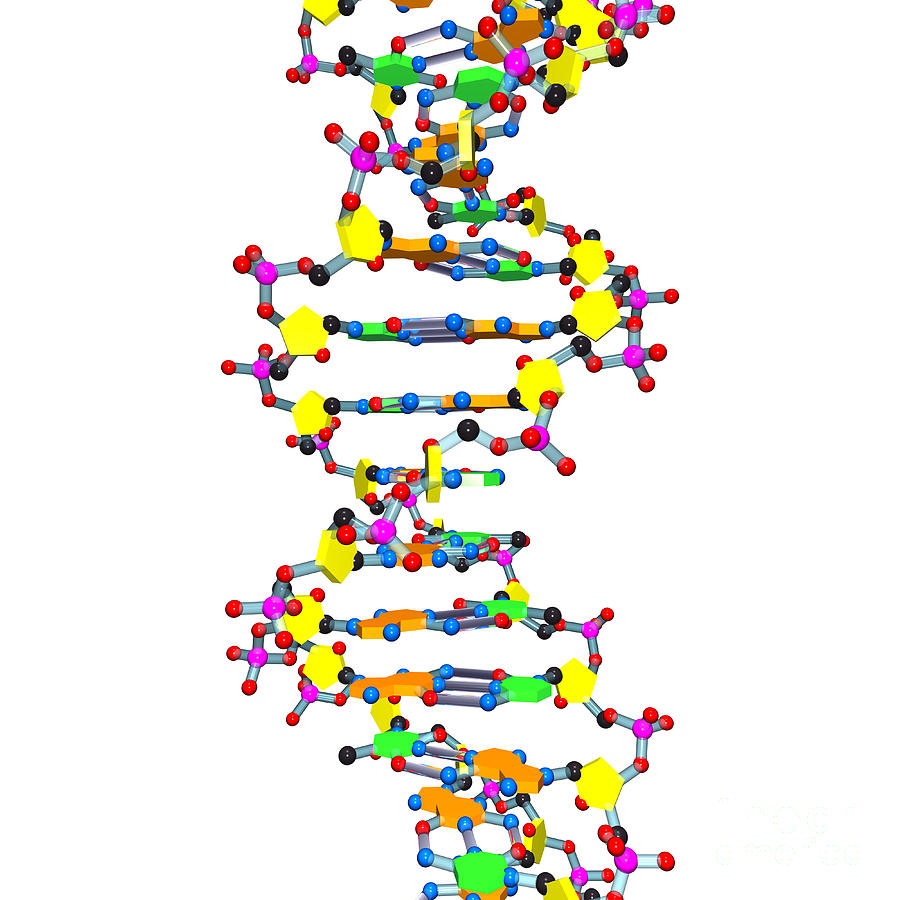 |
Here’s a section of DNA. Look it over carefully. Which segments have purpose? |

Zoologist Ernst Mayr worked to to clear things up by sorting out a terminology . In the glossary to his book, One Long Argument, Charles Darwin and the genesis of modern evolutionary thought, he offers these definitions:
Finalism - A belief in an inherent trend in the natural world toward some preordained final goal or purpose, such as the attainment of perfection. See Teleology.
Teleology - The actual or only seeming existence of end-directed processes in nature, and their study. See Finalism.
Teleomatic process - A seemingly end-directed process that is strictly controlled by natural laws such as the law of gravity or the first law of thermodynamics.
Teleonomic process - A process or behavior that owes its goal-directedness to the operation of a program.
Above, Robert Wright and Massimo Pigliucci weigh the concepts of teleonomy and teleology and discuss which of the terms they find to be applicable to various cases. The Wikipedia entry for Orthogenesis provides additional historical information about this distinction within evolution theory.
Teleology vs teleonomy
Admittedly, nature can seem to serve diverse purposes, but any such perception is an illusion--at least sometimes.
Depending on whom you ask, “purpose” in nature could be a concept up for grabs. Likewise with occurrences in nature deemed happenstance or those deemed programmatic. The latter case includes the predictable life cycles of complex organisms.
Such life cycles, the pre-programmed sequence of biological events called development, has a teleological nature. Given an accommodating environment, the end product inheres in the process. And given knowledge of the species (and breed), the adult form is more or less predictable, having been pre-programmed from the outset.
Evolution, however, by definition, or at least by tradition, is non-teleological. It is a process of organic change that can look like development—but it operates without a program, plan or inherent endpoint. Or, so the official story goes. In any case, development is teleological whereas evolution is not, according to current orthodoxy.
Decades of research and theorizing have produced this bias. Scientists of various stripes have interpreted the available data in such terms. But it all goes topsy-turvy if evolution is an instance of development, because then the teleological language of development will apply, more or less, to evolutionary change. And then the question will arise as to upcoming stages of the pre-programmed terrestrial (and extraterrestrial) life cycle.
In his writings, evolutionary biologist Ernst Mayr strove to distinguish developmental change (ontogeny) from evolutionary change (phylogeny), a project that produced a vocabulary of inter-related terms. This project aimed to clear up confusions surrounding biological applications of teleology. Confusions arose because many things in nature can appear to be teleological, or driven toward a goal or pre-determined endpoint. But for ideological and other reasons some such processes, such as evolution, cannot be framed as any unfolding of pre-determined stages, according to orthodoxy.
—
Thomas Nagel
Mind and Cosmos
The concept of teleology has been around since Aristotle. Teleonomy, a coinage dating back no earlier than the mid-1950s, is meant to designate the mere appearance of an unfolding program where there is none. Application of the terms can be nuanced, but the apparent job of teleonomy is to sideline attempts to frame evolution as pre-programmed or teleological. Evolution has no inherent direction or endpoint, unlike the (teleological) maturation of complex organisms, according to mainstream science.
Whether either or similar processes produce happenstance or pre-programmed outcomes seems not to be a trivial question. Mayr (among other biologists) was most insistent about evolution’s lack of any kind of pre-programming, as reflected in these passages from his article “Teleological and Teleonomic: a new analysis” (Boston Studies in the Philosophy of Science, Vol. XIV). From various angles, the article throws light on these topics.
“If ‘teleological’ means anything it means ‘goal directed’. Yet, natural selection is strictly an a posteriori process which rewards current success but never sets up future goals. [. . . .] Natural selection rewards past events, that is the production of successful recombinations of genes, but it does not plan for the future. This is, precisely, what gives evolution by natural selection its flexibility. With the environment changing incessantly, natural selection—in contradistinction to orthogenesis—never commits itself to a future goal. Natural selection is never goal oriented. It is misleading and quite inadmissible to designate such broadly generalized concepts as survival or reproductive success as definite and specified goals. “
“One of Darwin’s greatest contributions was to have made it clear that teleonomic processes involving only a single individual are of an entirely different nature from evolutionary changes. The latter are controlled by the interplay of the production of variants (new genotypes) and their sorting out by natural selection, a process which is quite decidedly not directed toward a specified distant end. A discussion of legitimately teleological phenomena would be futile unless evolutionary processes are eliminated from consideration.”
“Part of the confusion [between the meanings of teleology and telonomy] is due to the fact that the term ‘teleological system’ has been applied to two only partially overlapping phenomena. One comprises systems that are potentially able to perform teleonomic actions, like a torpedo. The other comprises systems that are well adapted, like the eye. To refer to a phenomenon in this second class as ‘teleological’ in order to express its adaptive perfection, reflects just enough of the old idea of evolution leading to a steady progression in adaptation and perfection to make me uneasy. What is the telos toward which the teleological system moves?”The star larvae hypothesis suggests an answer to that last question. In any case, all such difficulties subside once evolution is understood to be an instance of development.
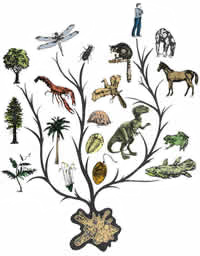 |
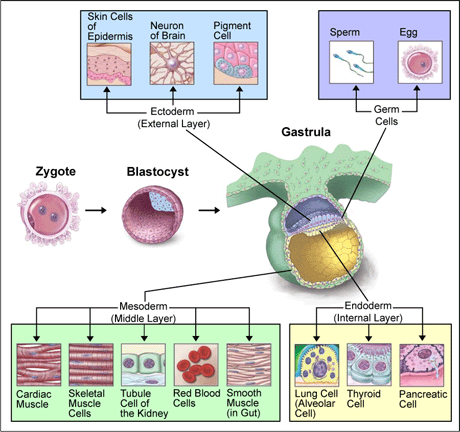
Given the vast explanatory power attributed to natural selection when it comes to evolution, why does science then stoop to invoking a "genetic program" (or synonymous concept) when it comes to explaining the development of an organism? Both evolution and development—phylogeny and ontogeny—involve descent from a common ancestor (an ancestral species and a zygote, respectively), with descendants competing and cooperating in a shared environment. So, why the need to invoke a ghost in the machine, the genetic program, when it comes to development? Why is variation + selection sufficient to explain the differentiation of species during evolution but insufficient to explain the differentiation of cells during development? What criteria can science articulate to determine when to invoke natural selection and when to invoke a program when explaining descent with modification? Applied even-handedly, would any such criteria disqualify phylogeny from being explained by a program? In principle, what sort of observation would establish the presence or absence of underlying instructions directing either process? |
The Second Law of Thermodynamics and Complex Systems
— F.
M. Cornford
Before
and After Socrates
— Evelyn Fox Keller
The Century of the Gene
Although science rejects the idea that ends are imminent in the means of evolution, nature nonetheless proceeds in a preferred direction. The Second Law of Thermodynamics asserts that processes tend to change over time specifically in a direction away from organized complexity and toward equilibrium—toward greater entropy. Even though it pulls things, inexorably, in a certain direction, the tendency to converge on maximal entropy does not constitute a teleological program, in the scientific view.
That certain dynamic systems grow in the opposite direction, away from equilibrium, yet operate stably in their disequilibrium, is readily observable. But, according to normal science, these anti-entropic systems, such as biological cells, ecosystems and galaxies, do not rely on teleological programs to arrive at their complex, stable forms. Like systems that devolve toward maximal entropy, anti-entropic systems are not driven by purpose or function, in the scientific view. They are flukes or, in the context of complexity theory, "emergent" systems of self organization. In any event, normal science does not assign to them any teleological aims.
Among these interwoven ideas, most significant for the star larvae hypothesis is the normal scientific view that evolutionary descent—phylogeny—is nonteleological but that development of individuals—ontogeny—is teleological. That is, the former proceeds without the benefit of an inherent direction, but the latter does benefit from inherent direction. The hypothesis challenges this received doctrine.
The star larvae hypothesis sees in the churning of evolutionary history the metabolic churning of a developing organism. Evolution unfolds according to a developmental plan. Evolution is teleological.
NEXT > Ontophylogeny, or Evelopment

The Star Larvae Hypothesis:
Stars constitute a genus of organism. The stellar life cycle includes a larval phase. Biological life constitutes the larval phase of the stellar life cycle.
Elaboration: The hypothesis presents a teleological model of nature, in which-
Stellar nebula manufacture bacteria and viruses in their interiors as they cool.
-
Biology evolves within an ontogenetic program that in its entirety, on- and off-planet, constitutes a generational life cycle of the stellar organism.
-
Technology plays a necessary role in evolution. It enables biological life to emigrate from planets to weightless space.
-
Postplanetary life manufactures the protons needed to create, then metamorphoses into, new stars.
-
A prescient complex of celestial religious motifs expresses humankind’s stellar calling. The star is the human imago.
-
Nature's metabolism encompasses the organic and the inorganic in a continuum of anabolic and catabolic exchanges.
| Tweets by @Starlarvae | Social Media =
|
| |

Home | Blog | About | Videos | Contact | Text Copyright ©2004-2017 Advanced Theological Systems. All Rights Reserved.
Privacy Statement: We use third-party advertising companies to serve ads when you visit our website. These companies may use information (not including your name, address, email address, or telephone number) about your visits to this and other websites in order to provide advertisements about goods and services of interest to you. If you would like more information about this practice and to know your choices about not having this information used by these companies, visit the Google ad and content network privacy policy.