Tweet
  Home | Blog | About | Videos | Contact Home | Blog | About | Videos | Contact
|
|
The
Star Larvae Hypothesis
Nature's Plan for Humankind
Part 2. Star Larvae
The Stellar Organism
Their stable disequilibria, catalytic metabolisms, periodic physiological cycles, and homeostatic feedback controls qualify stars as living organisms.
In
In
the Beginning

Spiral galaxies in this way exhibit a managed degree of homeostasis—an essential characteristic of living organisms.
However, as eager as Gribbin is to classify the Milky Way as an organism, he is less generous when it comes to individual stars. As dynamic and lively as they are in terms of their internal processes, stars don't make the cut. "The life processes that create and maintain the spiral structure in disk galaxies start with stars," Gribbin acknowledges, and he concedes that stars possess a trait distinctive of living things: "A star like our sun is itself, of course, in a state far from equilibrium." But we should not be misled by that fact: "Not even the keenest enthusiast for the Gaia hypothesis would argue that the sun is alive in the way that the Earth and the Milky Way are alive, because the sun is doing the best it can to reach equilibrium."
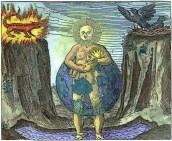 "The most useful tool astronomers have for studying the way
stars change as they age is called the Hertzsprung-Russell diagram, after
the two astronomers who pioneered its use. Stars live for so long and change
so slowly, by and large, that there is no hope of studying stellar evolution
by watching an individual star or two age. But the H-R diagram enables
astronomers to do the equivalent of a botanist who studies a forest of
trees that includes seedlings, saplings, and mature specimens and uses
those studies to work out the life cycle of a tree."
"The most useful tool astronomers have for studying the way
stars change as they age is called the Hertzsprung-Russell diagram, after
the two astronomers who pioneered its use. Stars live for so long and change
so slowly, by and large, that there is no hope of studying stellar evolution
by watching an individual star or two age. But the H-R diagram enables
astronomers to do the equivalent of a botanist who studies a forest of
trees that includes seedlings, saplings, and mature specimens and uses
those studies to work out the life cycle of a tree."
—
John Gribbin
Blinded
By the Light
Gribbin’s dismissiveness reveals a bias. The sun might be succumbing to entropy—rolling down the slope of potential energy toward equilibrium—despite its best efforts, just as are all of us who find ourselves past mid life. But one would not likely characterize a healthy, growing child as "doing the best it can to reach equilibrium." Why would one characterize a healthy, growing young star that way? The suitability of the characterization—heading toward equilibrium—depends on life-cycle stage, not on the particular organism, biological or stellar, under consideration.
Stars embody such a striking number of organismic traits that a reclassificication is called for. The star larvae hypothesis extends the notion of being alive specifically and explicitly to stars. And if stardom pulls history into the future, then humans have some responsibility to facilitate the program. The star larvae hypothesis situates not only natural history in the context of stellar ontogeny, but pulls along human history as well. We might not be the captains of our fate that we like to imagine ourselves to be. Human history is as much an unfolding of natural processes as is evolutionary history, or the early stages of stellar ontogeny.
The stellar organism exhibits the following traits.
Catalytic Metabolism
Stars maintain themselves by releasing nuclear energy from the smaller atomic nuclei that they fuse into larger nuclei. Animals maintain themselves by releasing chemical energy from the foods they eat to produce the chemical constituents of their bodies. Plants exploit freely available solar energy to produce the bodily constituents that they need. Like biological metabolism, a stellar metabolism uses energies released by its internal processes to maintain itself in a state of stable disequilibrium.
Stellar metabolism consists of interwoven processes of nuclear fusion and fission that maintain the gross structures and processes of the star's anatomy and physiology. These processes correspond to the anabolic (building up) and catabolic (tearing down) processes, respectively, that compose biological metabolism. Newborn stars consume hydrogen nuclei (unattached protons), exclusively. The processes that fuse these protons into the nuclei of larger atoms occur by various, specific nuclear reactions. Inside stars, reactions, such as the proton-proton chain, the triple alpha process, and the CNO cycle, build up larger atomic nuclei from individual protons. The term for this process is nucleosynthesis.
The prevalence among the above listed and other reaction pathways, relative to one another, varies with the age of a star, a situation that parallels metabolic changes that occur in aging biological organisms. A newborn star fuses individual protons (hydrogen nuclei) into proton pairs (helium nuclei) during the star's hydrogen burning stage. Eventually too few free protons remain to keep the process going, but sufficient numbers of helium nuclei have been created for the star to shift into a hotter, helium-burning phase. This nucleosynthetic process fuses helium nuclei into carbon, nitrogen, oxygen and other larger atoms. Eventually a star will burn carbon and larger atoms and fuse them into yet larger ones, with iron defining the upper size limit of atoms that are formed through the metabolic processes that dominate the life of a typical star. Shorter-lived but more energetic processes produce the atoms that are heavier than iron. These processes take place during the explosive, high-energy events that constitute the death throes of a star.
In
a star bigger than the sun, a peculiarity during the hydrogen
burning phase underscores a shared behavior of stars and biological organisms. If the particle cloud that gives birth to a star
contains enough carbon, nitrogen, and oxygen, then the star will initiate a
mode of hydrogen burning called the CNO cycle, in which it fuses hydrogen
nuclei into helium nuclei through a catalytic process. Catalysis is a
transformative process that relies on intermediaries that participate in reactions
but emerge unchanged once the reactive cycle completes. Enzymes provide an example from biology. Certain enzymes will bond to particular molecules, introduce those molecules
to others, then detach themselves from the molecules that they have joined together. Catalytic enzymes emerge unchanged by the reactions that they catalyze.
 During
the catalytic CNO cycle, isotopes of carbon, nitrogen, and oxygen exchange
protons, and emit subatomic particles through radioactive decay, in a specific
sequence of transformations that yields helium from an initial union
of hydrogen and carbon. Each time a helium nucleus is emitted from the
process it leaves behind the original carbon isotope, which is then free
to bond with another hydrogen nucleus—proton—and begin
the cycle again. The process is a true catalysis. When the manufactured
helium is released, the initiator of the process is regenerated and begins
the cycle again.
During
the catalytic CNO cycle, isotopes of carbon, nitrogen, and oxygen exchange
protons, and emit subatomic particles through radioactive decay, in a specific
sequence of transformations that yields helium from an initial union
of hydrogen and carbon. Each time a helium nucleus is emitted from the
process it leaves behind the original carbon isotope, which is then free
to bond with another hydrogen nucleus—proton—and begin
the cycle again. The process is a true catalysis. When the manufactured
helium is released, the initiator of the process is regenerated and begins
the cycle again.
Notice the elements involved in this catalytic process: carbon, hydrogen, oxygen and nitrogen. This group of elements, sometimes
designated by the abbreviation CHON, constitutes up to 90 percent of the
mass of biological protoplasm. Surely it is s a strange coincidence that
these elements also play starring roles in the catalytic metabolisms of stars. No reason exists, a priori, to expect that the nuclear and chemical properties of these elements would dovetail so neatly. The star larvae hypothesis sees in the coincidence evidence of familial descent.
Stellar Anatomy and Physiology
In addition to exploiting catalysis, stars exhibit a list of attributes readily couched in biological language. A star comprises internal arrangements of stable yet dynamically interacting subsystems that constitute its anatomy. The material and energetic exchanges within and among the subsystems constitute the star’s physiology.
Despite appearances, a star is an organized structure of discernible components arranged and interacting with one another in definite ways. It is not a homogeneous blob of hot gas. The anatomy of our sun, for example, comprises, an inner core within which nucleosynthesis occurs, a radiative layer that carries energy out from the core by radiation, and a convective layer that carries the energy further by convection. This onion-like structure continues outward from the core to the periphery, through the photosphere, the chromosphere, and, at the outer fringes, the diffuse corona.
This layered body plan is maintained physiologically. The photosphere, for example, includes structures that solar physicists call granules, which are the tops of convection cells that cover the sun. The convection cells underlying the granules constitute a circulatory system that shuttles material between the interior and the surface of the solar body. At the surface the fluid material circulates according to multiple flow components (rotation, cellular convection, oscillations, and meridional flows).The granules themselves compose supergranules, whose fluid motions concentrate magnetic fields to produce a weblike pattern of field lines—the chromospheric network—that continually evolves over the sun’s surface. The photospheric circulatory system includes magnetic field markers—the familiar sunspots—and the smaller, brighter spots called faculae. A system of interlocking processes is at work here to maintain a discernible, complex structure in a state of stable disequilibrium and which exhibits a level of complexity highly suggestive of a living organism.
Stellar Periodicity
As with
other organisms, a star's internal processes are cyclic. In biological organisms, cyclic processes include the familiar circadian, ultradian and infradian
rhythms of animals, such as sleep/wake, respiratory and estrus cycles. Gaia, too, pulses rhythmically, with tidal, seasonal, glacial, and other cycles. The sun exhibits the same tendency.
Its rhythms include the well-studied eleven-year
sunspot cycle, along with a 76-year oscillation in its volume. NASA’s
orbiting SoHo observatory during the 1990s revealed a rapid five-minute
cycle of helioseismographic activity—of sound waves resonating
through the body of the sun (for details, see "Solar
and Stellar Activity Cycles
Stellar Homeostasis
Stars and biological organisms both also depend on feedback to maintain homeostasis, or internal stability. The sun uses feedback controls specifically to maintain its internal temperature, which must remain within a limited range to keep the sun viable. If it were to cool excessively, the sun would implode under its own gravity. If it were to heat up excessively, it would fly apart. The sun keeps blazing because its tendency to expand—an effect of its heat—is countered precisely by its tendency to contract—an effect of its gravity. The temperature range at which these two countervailing forces remain balanced corresponds to the range that keeps nucleosynthesis proceeding in the way required for the sun to continue doing what it does.
Despite the foregoing parallels between stellar and biological life, at least one essential biological process has no obvious counterpart in the lives of stars. That process is reproduction. The star larvae hypothesis fills the gap by accounting for the stellar reproductive cycle.
Stellar Reproduction
Stellar reproduction
is addressed, ostensibly, by the standard scientific model of the stellar "life
cycle."
When stars die, they do so explosively, expelling their bodily
material into the space around them. The death leaves behind a dense core,
which persists as a brown dwarf, neutron star, or black hole, depending
on the size of the original star. The material that is ejected into space enriches
nearby particle clouds, from which new stars form. This recycling
of material from one generation of stars to the next resembles reproduction. But it resembles the fertilization of roots more than it does
the production of seeds. It is a reproductive pseudo-cycle.
The recycling of material from
old stars into new ones does not produce new unattached protons, which are the spores/seeds from which new stars develop.
In the first chapter of his book The Fifth Miracle, physicist Paul Davies suggests criteria by which to determine whether a thing/process should be considered alive or inanimate, and his list suggests that stars be included among nature’s living things, but he fails to invite them to his party. Here are the properties that Davies suggests can help distinguish the living from the nonliving along with commentary from the star larvae hypothesis:
Autonomy or self-determination. This property would seem to apply at least as much to stars an to biological organisms, which depend on other organisms in their environment (to serve as food if nothing else). But whether stars depend in any comparable way each other or something else is unclear. Nonetheless, stars will tend to associate to form galaxies, perhaps these are kinds of stellar societies, suggesting an interdependence among stars.
Reproduction. The star larvae hypothesis assigns this bio-property to stars, and the hypothesis proposes to spell out the stages of the stellar life cycle.
Metabolism. Nuclear fusion and fission reactions, some of which involve catalysis inside stars, constitute the stellar metabolism.
Nutrition. Stars consume atoms, fusing them into larger atoms, a process that releases energy, which keeps a star’s metabolic processes operating.
Complexity. Stars are complex in their components, the interactions among the components, and the changes in those interactions as a star ages.
Organization. The specialized components and processes that make up a star are organized and interdependent and balanced precisely so as to keep a star burning for billions of years.
Growth and development. Stars are born, develop through predictable stages, age and die.
Information content. Davies writes about information being meaningful in the context in which it is specified in living organisms. Whatever is meant by such language will apply as much to stars as to biological organisms, or so the star larvae hypothesis asserts.
Hardware/software entanglement. The techno-metaphors continue as Davies assigns definitive significance to the relationship between proteins and nucleic acids in biological organisms. The “entanglement” involving the two kinds of substances he implies is a hallmark of living organisms. But the application should be more circumscribed; it characterizes biology. The star larvae hypothesis proposes that biology is but one stage in the life cycle of the stellar organism. Whether the entanglement metaphor is applicable to other stages remains to be worked out.
Permanence and change. This attribute bows its head to “the Darwinian imperative.” But the star larvae hypothesis asserts that evolution is a developmental process, a stellar life cycle unfolding, in which no need exists to make the hypothesis comfortable in a Darwinian frame.
In fairness to Davies, he does not present the above list of criteria dogmatically, and he points out shortcomings of the individual criteria. But in summary, he states that, “[...] broadly speaking, life seems to involve two crucial factors: metabolism and reproduction.” And there the star larvae hypothesis finds itself in agreement with the Davies.
The star larvae hypothesis proposes that the stellar reproductive cycle resembles biological reproduction insofar as it comprises discernible stages, each transitioning into the next in a predictable developmental sequence. The hypothesis proposes that stars constitute only the adult phase of the organism's life cycle and that the cycle also includes a larval phase. As with some biological organisms, star larvae bear little resemblance to their adult form.
Once bacteria and viruses arrive on a suitable planet the
larval phase of the stellar life cycle—biology—unfolds.
The larvae exploit the planetary resources,
and their population over time differentiates to include a type that on Earth goes by the name Homo sapiens and that is equipped by its nature to initiate the next vital phase of the stellar life cycle. This
avant-garde type constructs from the material resources of the incubator planet
complex niches—cities. It evolves
symbiotically with its evolving technologies and becomes highly
domesticated—neotenous. Eventually, the larvae migrate to new ecological niches that they construct in the orbital space around the incubator planet. The move to orbital —weightless—niches triggers a mutation/metamorphosis in the larvae. They develop into the next stage of the stellar life cycle, what might be called the angelic stage.
Researchers, called anthropologists, who study the habits of Homo sapiens testify to a peculiar behavior that betrays an intuition
of stellar metamorphosis. As if by precognition, the larvae fashion
images of themselves as glowing and airborne. Larval
lore points to the sky as the abode of "enlightened" fellows,
a place and condition to which larval institutions called religions admonish adherents to aspire. While the drive to join the celestial
illuminati of myth expresses itself through religious art and lore, the drive to join the celestial illuminati of the physical sky—the stars—expresses
itself through aerospace
engineering,
NEXT > Astrolatry,
Astrotheology and Astral Religion
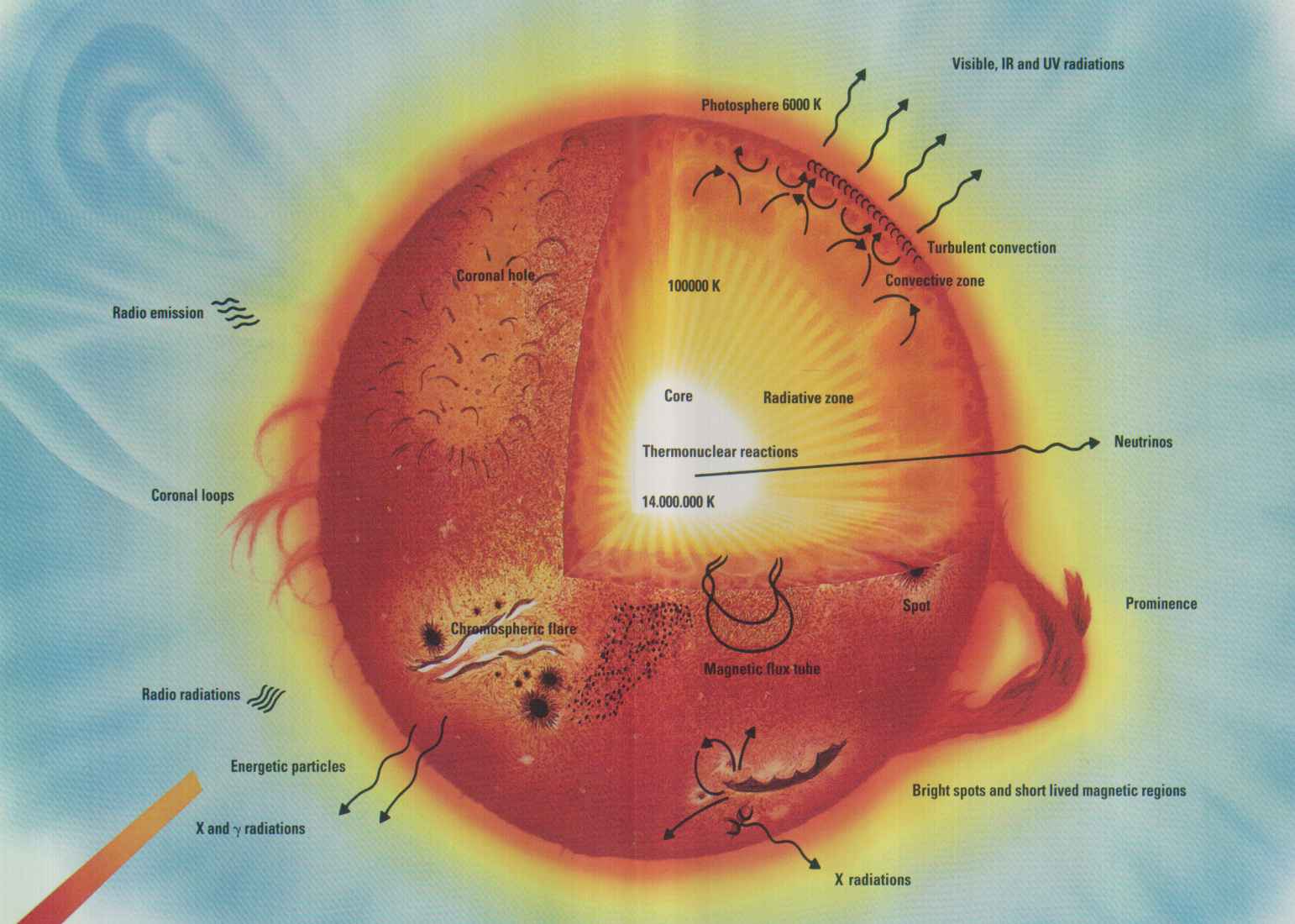
Solar/stellar Anatomy from CWRU -- http://burro.cwru.edu/Academics/

The Star Larvae Hypothesis:
Stars constitute a genus of organism. The stellar life cycle includes a larval phase. Biological life constitutes the larval phase of the stellar life cycle.
Elaboration: The hypothesis presents a teleological model of nature, in which-
Stellar nebula manufacture bacteria and viruses in their interiors as they cool.
-
Biology evolves within an ontogenetic program that in its entirety, on- and off-planet, constitutes a generational life cycle of the stellar organism.
-
Technology plays a necessary role in evolution. It enables biological life to emigrate from planets to weightless space.
-
Postplanetary life manufactures the protons needed to create, then metamorphoses into, new stars.
-
A prescient complex of celestial religious motifs expresses humankind’s stellar calling. The star is the human imago.
-
Nature's metabolism encompasses the organic and the inorganic in a continuum of anabolic and catabolic exchanges.
| Tweets by @Starlarvae | Social Media =
|
| |

Home | Blog | About | Videos | Contact | Text Copyright ©2004-2017 Advanced Theological Systems. All Rights Reserved.
Privacy Statement: We use third-party advertising companies to serve ads when you visit our website. These companies may use information (not including your name, address, email address, or telephone number) about your visits to this and other websites in order to provide advertisements about goods and services of interest to you. If you would like more information about this practice and to know your choices about not having this information used by these companies, visit the Google ad and content network privacy policy.